Michael
Garrick and
Nette Robinson 'Remembered Time'
Prolific
composer and pianist Michael
Garrick is a legend of UK jazz, often called The English
Ellington for the depth, originality and beauty of his musical
vision over fifty years. His latest collaboration is with the expressive
singer Nette Robinson on originals, standards and, to mark the thirtieth
anniversary of his death, work by the great pianist Bill Evans.
Not to be missed!
Listen to Michael and
Nettes music here,
here
and here.
'When the Big Audit is completed, Britain will find
itself in trouble for not having disclosed a national asset on the
scale of Michael Garrick
The Penguin Guide to Jazz on CD
truly of world class
John Dankworth
'Mike's inventiveness,
wit and zest for musical exploration is little short of
uncanny'
Humphrey Lyttelton
Admission - £7 / £6 (concession)
SUNDAY 3 OCTOBER
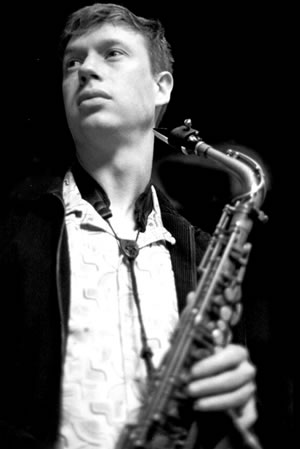
Photograph
by Jerry Storer
Simon
Spillett
& The Chris Ingham Trio
BBC JAZZ AWARDS 2007 RISING STAR; JAZZ JOURNAL MAGAZINE RECORD OF THE YEAR 2009 FOR 'SIENNA
RED'
Virtuoso tenor saxophonist Simon
Spillett is a player of jaw-dropping ferocity in the mould of
Tubby Hayes and Johnny Griffin with whom he shares a love of dare
devil tempos and all-out, no-holds-barred, intensity. One of the
most entertaining of the new wave of young musicians, Spillett always
delivers a high-energy performance of standards and striking originals.
With muscular support from Chris Ingham (piano), Ivars Galenieks
(double bass) and Russell Morgan (drums). Visit Simon's website
here
and watch him blowing up a storm on 'Cherokee' here
Another
Setting composed by Simon Spillett. Taken from the album
Introducing Simon Spillett (Woodville WVCD 116)
He is the Lewis Hamilton of the tenor saxophone, and other
players gulp when they hear him. It's not just his mastery of the
tenor saxophone, phenomenal though that is, but the absolute conviction
of his playing that is so impressive
The Observer
Spillett is a bruising scruff-of-the-neck hard bopper who
has absorbed all the giants generates huge excitement and
swagger
Mojo Magazine
Admission
- £7 / £6 (concession)
SUNDAY 7 NOVEMBER
The
Nigel Price Organ Trio
WINNER
OF BEST JAZZ ENSEMBLE IN THE 2010 PARLIAMENTARY JAZZ
AWARDS
When
the guitarist formerly with The James Taylor Quartet last visited
Milestones he recorded his new album, Live. Now he returns
with his funky and hard-swinging band performing fiery originals
and standards in the spirit of Wes Montgomery, Jimmy Smith and Jack
McDuff. Prices energetic voice skilfully fuses flowing bebop
lines and the earthy wail of the blues while petrol is thrown on
the fire by the great Pete Whittaker (Hammond organ) and Matt Home
(drums). An exhilarating group, not to be missed! Listen to the
band's music here
and here
and watch a choice of YouTube footage here
He
stands out as a really class performer
Humphrey Lyttelton
' a real killer
London Evening Standard (CD of the week)
I first encountered Nigel when I played percussion in The
James Taylor Quartet. He blew me away then and he does now
Snowboy, Blues and Soul magazine
Admission - £7 / £6 (concession)
SUNDAY 5 DECEMBER
Trish
Clowes's
Tangent
Tenor saxophonist and
composer Trish Clowes showcases original material from her debut
album produced by Gwilym Simcock that distils the influences of
Wayne Shorter, Astor Piazzolla and modern classical music into a
take on contemporary jazz
that is both intelligent and quietly elegant. With a slew of the
UKs top young players in support - Chris Montague (guitar),
Calum Gourlay (double bass), James Maddren (drums). Listen to Trishs
music here
and here
Clowes
is an extremely gifted writer her tenor tone is round, sure
and pure, sometimes almost Getz-ian,
Chris Parker, Jazzwise magazine
Part of a national tour
supported by Jazz Services
Admission - £7 / £6 (concession)
SUNDAY 2 JANUARY 2011
TBA
SUNDAY 6 FEBRUARY 2011
The
Kristian Borring Quartet
The
Danish guitarist and composer Kristian Borring steers a steady course
through original material from his first album that is both elaborate
and gently propulsive. Borrings clear-sighted improvisations
navigate changing time signatures, melodic grooves and rich harmony
with the vibrant support of Arthur Lea (piano/Fender Rhodes), Spencer
Brown (double bass) and Jon Scott (drums). Listen to Kristian's
music here
and here
a
rising talent on the new London jazz scene
Time Out
' mixes post bop lines with more contemporary abstract sounds
Jazzwise magazine
Admission - £7 / £6 (concession)
*PLEASE NOTE*:
details of concerts and musicians appearing are correct at the time
of writing although changes are sometimes necessary. Please feel
free to check with us before attending.
Somebody
who decides to play jazz for a living knows he will struggle for
the rest of his life, unless he opts for predictable and soothing
compromise. Honest jazz involves public exploration. It takes guts
to make mistakes in public, and mistakes are inherent. If there
are no mistakes, it's a mistake. In Keith Jarrett's solo improvisations
you can hear him hesitate, turn in circles for a while, struggle
to find the next idea. Bird used to start a phrase two or three
times before figuring out how to continue it. The heart and soul
of improvisation is turning mistakes into discovery. On the spot.
Now. No second draft. It can take a toll night after night in front
of an audience that just might be considering you shallow.
From 'Close Enough For Jazz', Mike Zwerin (1983)
Now,
divine air! Now is his soul ravished! Is it not strange that sheeps'
guts should hale souls out of men's bodies? Well, a horn for my
money, when all's done.
From 'Much Ado About Nothing' (Act II, Scene iii), William Shakespeare
(1600)
Onstage,
he storms inwardly, glaring at his audience, wincing at his trumpet,
stabbing and tugging at his ear. Often his solos degenerate into
a curse blown again and again through his horn in four soft beats.
But Miles can break hearts. Without attempting the strident showmanship
of most trumpeters, he still creates a mood of terror suppressed
- a lurking and highly exciting impression that he may some day
blow his brains out playing.
Barry Farrell, writing in Time Magazine (February 28 1964)